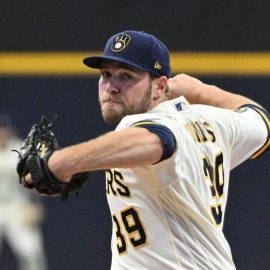
A Yovani Gallardo Theme Song

Written by Jess Lemont on .

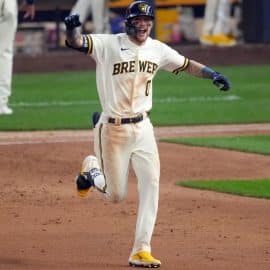
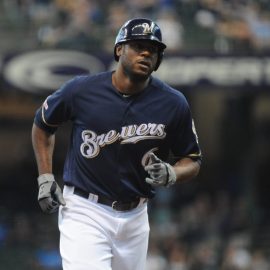
A musical description of Yovani Gallardo. Not sure if you could call it a powerpop instrumental...it's an instrumental, at the very least.

I haven't found where the html editor is on here, yet. It would be more convenient to eventually embed the Soundcloud player on this page, so I'll find out what I can do.

Music/Artwork by J. Lemont

no comments

Yuniesky Betancourt Must Be the Greatest Teammate of All Time (Because His WAR is Awful)

Written by Enrique Bakemeyer on .

(Image: Dilip Vishwanat/Getty Images)

It’s no secret Yuniesky Betancourt has turned about to be who fans thought he was, his uncharacteristically hot April notwithstanding.  While no one expects much from Yuni at this point, a recent blog post by NBC Sports columnist Joe Posnanski really put Betancourt’s lack of productivity in perspective:

Betancourt is well under replacement level again -- 1.1 wins under replacement already. And he has a chance to do something. If the Brewers will just keep playing him every day, and he can maintain this pace, he will become the first player since Bill Bergen more than 100 years ago to score SIX CONSECUTIVE SEASONS of negative WAR.

Since Posnanski isn’t local, he seems astonished at how Yuni has been used so far this season, like playing him at first base, and batting him fifth or fourth in the lineup.  (In fairness, Yuni went 2-for-5 his first time batting cleanup.)  The Brewers have had a number of key injuries, and the middle of the lineup was underperforming in the first two months of the season, so throwing Yuni out there had a certain “well, why the hell not?” quality to it.  Still, anyone trying to make the case that Betancourt isn’t an ineffective player would have their work cut out for them.

It is interesting to consider how Yuni has been a beneficiary of circumstance.  He’s been re-signed by two teams – Kansas City and Milwaukee – that both knew he was average at best.  With his current stint in Milwaukee, Betancourt seems to have a job primarily because Aramis Ramirez has been struggling with a bum knee, and Alex Gonzalez was somehow even less productive.  Betancourt’s a survivor.

What does Yuni have going for him (obviously not baseball skills like fielding and getting on base)?  When it was revealed in spring training that Betancourt was coming back for a sequel with the Brewers, Doug Melvin had this to say“[T]he guy does good things. There are a lot of things we look at. He’s versatile, has good, strong hands; good strength. He’s good in the clubhouse and is a good teammate.”

Is being a good teammate enough given Yuni’s historically poor WAR?  I did some googling to find evidence that the Royals or Mariners said anything about Betancourt’s positive clubhouse influence.  Sure enough, when Kansas City brought him back after in the 2011 season, general manager Dayton Moore said, “He brings a right-handed bat with some power and is a guy we know fits in well in the clubhouse.”  What do you know?

On the other hand, at the end of his tenure in Seattle, Yuni was benched due to lack of effort.  One of his teammates at the time said, “You can't play a guy who doesn't work hard on a team where everyone else busts their ass.”  So apparently Yuni the good teammate only started coming around in the last four years or so.

Hopefully, Brewers fans will one day hear the fabulous details of Betancourt’s endearing clubhouse antics.  Until then, this much can be said in Yuni’s defense – for a guy with a negative WAR, at least he’s not as expensive as Josh Hamilton.

no comments

There's So Much Aoki, You Have No Idea What to Do - (This Includes An Explanation)

Written by Jess Lemont on .

I've really been bothered by something involving the previous artwork. My closest guess would be that I forgot to include a nightmare-free version, as well. This is not Norichika Aoki's fault, at all. It's mine, because I can't draw facial hair, so that will not be included in this one. Also, there's a nice background that is kind of like what you'd see on a postage stamp. Come to think of it, the original picture looks more like no. 7 than this one.

Some bonus material - you'll end up meeting someone by the name of mcanderson, if you go to that link.


no comments

John Lackey's Control, and (possible lack of) Self-Control - A Look At Monday's HBP

Written by Jess Lemont on .

Note: I wrote a good majority of this piece early Tuesday morning, but (regretfully) put it aside after seeing the news about the Dodgers/Diamondbacks bean ball war. I thought it would be better to write about that. I've since changed my mind, because I think it's still a good idea to look at the Rays/Red Sox incident, where the Boston RHP John Lackey hit Tampa Bay outfielder, Matt Joyce on Monday. I was especially interested in some of the statements made by Tampa Bay Rays IF Sean Rodriguez and manager Joe Maddon, along with the pitch itself, prior pitches from Joyce's two plate appearance, prior to the 6th inning, and at intimidation Here are some of my thoughts on the incident, below:

- - - -

You've probably seen the quotes from Tampa Bay Rays IF, Sean Rodriguez and manager Joe Maddon in various places, already, if you've been following the story of John Lackey throwing a four-seamer up and in, hitting Matt Joyce in the back. Here is part of it, via Craig Calcaterra at Hardball Talk:

“It was very unmanlike to deny that you did it on purpose, that’s basically what I was addressing with him when we were on the field,” Rays infielder Sean Rodriguez said Tuesday. “I played with (Lackey), I thought he was more of a man. But maybe he’s changed, I don’t know.”
-Rays IF, Sean Rodriguez


Here's more, this time from Joe Maddon, courtesy of Marc Topkin of the Tampa Bay Times (and linked in the above Hardball Talk piece).


"Rays manager Joe Maddon said hitting Joyce was "inappropriate" and Lackey was 'a bad teammate" for doing so as a Sox player could get hit in retaliation."


"A bad teammate"… I wonder - was Maddon was suggesting Lackey was going outside a certain code of conduct, and lost control of the situation on his own? Was there maybe reason to think even his own teammates didn't expect it?
When Joyce was hit during the 6th inning, Red Sox catcher, Jarrod Saltalamacchia, set up a target low/middle, and in the zone.

If anyone is wondering, I do have reason to believe Lackey could have hit Joyce on purpose. Although I might be wrong --- it certainly doesn't fit the pattern of where Lackey has normally pitched LHHs inside - for a bit more emphasis, here's the heatmap for the I'll post the heatmap associated with that link, too:  [1]


John Lackey has also had some good success against LHHs, this season: faced a number of LHH (152 L / 92 R) - despite 4 HR/2 HBP, he's limited them to a .240 BABIP, and they're batting .209 against him, while keeping them to a .277 Weighted On Base Average (wOBA) - although with a 12.1% HR/FB rate (which is considered poor, with the league average rate around 9.5% since 2002), he's also limited them to a LD% of 14%, and a GB% of 55.1%. So, left-handed hitters haven't had a whole lot of success, aside from when they manage to hit on in the air, and he's allowing them at a 30.8% rate. He's got good enough control where that pitch shown on the heatmaps seems kind of out of place.* Lackey's good splits against left-handed hitters indicate he hasn't had a huge amount of trouble establishing his part of the plate.
 

*Additionally,I'd like to add that I'm wondering that a pitch that would break up and in more than the specific four-seamer Lackey throws would be the most ideal for backing a hitter off the plate.

 
Moving on - or, back on topic to his outing on Monday night made the news by hitting Matt Joyce with that fastball. First of all, Matt Joyce hit a solo HR off John Lackey in the 1st inning (you can watch it, here).

I doubt it the home run was the reason for the alleged plunking. In the 2nd inning, Matt Joyce did this:


Actually, it's kind of tough to tell from the picture, but Joyce launched a fly ball to right field that went pretty well to the right of the foul pole, and on a 3-0 count. He appeared to be admiring it, but then basically looked like he was trying to recover from possibly insulting Lackey when he spun around and looked embarrassed and picked up his bat, again. He may have figured Lackey would have a reason to throw at him, so, it was either that he was coming to his senses and quickly thinking he should look like he was embarrassed about the mistake, or maybe he wasn't even thinking that far ahead, at all. But, I guess a caption could be "...oh...wait!" or something. I have my doubts, though, that the pitch that hit Matt Joyce was directly because of the long foul ball.

If a possible intentional plunking was on Joyce's mind at that point, there's a possibility he may have been thinking along these lines:
 

"They say the anticipation of death is worse than actually dying.Well, the anticipation of getting hit is a lot worse than actually being hit. You can't play your game. You think you're going to get drilled, so you aren't focused on hitting. You're focused on avoiding"
-catcher Randy Knorr, p. 43 of 'The Baseball Codes - Beanballs, Sign Stealing, & Bench-Clearing Brawls' by Jason Turbow [2]

If he was nervous about it, maybe it was tough to tell that inning (the 2nd) if he was fretting it. We could try looking at how the rest of the Plate Appearance went for him, here, at Brooks Baseball (what happened after pitch 4, which is the one he hit the long, loud foul ball on and then spun around to get the bat). Pitch 5 was at the top of the zone, and maybe could have been called a ball by Tom Hallion, but maybe not. He swung at it and hit it into the ground, and it didn't bounce very far and he was out, easily.

The reason I want to look at these PAs is because, as far as Matt Joyce is concerned, he's a very patient hitter, swinging at 23.3% of pitches outside the zone (o-Swing%), and 63.6% of pitches inside the zone (z-swing%). He's got a nice BB% of 11.3% (slightly down from last season, but good for 18th in the AL among batters with 200 Plate Appearances)* and he's been striking out less than 2012, at a 17.6% rate.

*Note: I used 200 or more PAs as a guideline, based on the correlation of hitter plate appearances with stabilization of various statistics.

Anyhow, after that inning, here's a description of what happened further, after Lackey had gotten the final out, from the Baseball Nation TB Rays fan site, DraysBay:
 

"On his way off the field it's apparent that Lackey yells at the Rays dugout, and post the commercial break we see Sean Rodriguez yelling right back. Rays 2, Red Sox 6."

Moving onto the 4th inning, though, nothing came of this. As far as Joyce's Plate appearance went, while we can't say if Joyce felt intimidated or not intimidated in the 4th without him saying so -it may not out of the realm of possibility to think he wasn't showing it, if it was true. Joyce took 3 middle-to-low pitches inside (not strikes - Got a borderline called strike, low and away, and, with Joyce's plate discipline, it would make sense not to offer at it. He  then fouled off pitch 5 (in the zone) - swung at pitch 6 (in the zone, slightly away, and just slightly away and above the middle of the zone, provided it's accurate enough).

His patient approach at the plate might indicate he wasn't going to let the possibility of Lackey hitting him affect that plate appearance. Maybe it's a stretch to look at various PITCHF/x tools in order to get any real sense of what a player may or may not have been thinking, but I feel like it's good to still see how much can be learned about the game through this raw data.

Back to this intimidation I keep bringing up! Was Lackey "supposed" to even do anything more than brush back Joyce for the display in the first place? By "supposed to," I mean to say, is this historically something accepted by players as a way to send a message to a batter who maybe showed up that pitcher -in Joyce's case, watching the long fly ball go foul and briefly dropping the bat. (before quickly recovering the bat)? If it was read as showboating, which, to me, seemed to be only borderline, at best - enough to where Lackey felt entitled to hit him.*

*to be clear, I'm never a fan of batters getting thrown at intentionally, or pitchers with poor control sending a message when they could accidentally hit a batter. I'd also love to just see the practice of intentionally hitting batters for any reason fade from "The Unwritten Rules," because then, ideally, retaliation would not be warranted...it'll never happen, though.
 

- - -

With the strong disapproval of Lackey's actions shown by Rodriguez and Maddon, is it possible Lackey felt (on his own) that he'd let a chance to intimidate Joyce go by, and lose control of his emotions? Especially if  Saltalamacchia didn't even expect it, gauging from the actual target he put up. Unless it was a slightly more sinister thing where that was all planned out. If the former is the case, what Maddon says about Lackey being a bad teammate makes a bit more sense, in that context. Also, there is the whole history of animosity between these two NL East teams, where the whole following of the code gets to be really confusing for me to keep track of! It did seem as though it was fresh grounds for Lackey to throw at Joyce, but it was wrong to do so on purpose, in the first place.

- - - -

[1]]Image courtesy of Fangraphs PITCHf/x heatmaps feature.

[2]Turbow, Jason. The Baseball Codes - Beanballs, Sign Stealing, & Bench-Clearing Brawls Pantheon Books (a division of Random House, Inc., New York) 2010


no comments

Betancourt, Chapman, and the Sordid Business of Defection

Written by Enrique Bakemeyer on .

(Image: AP/David J. Phillip)

This weekend’s three-game series between the Reds and Brewers includes two players – Yuniesky Betancourt and Aroldis Chapman – who took a more tortured path than most to the big leagues.  Both are Cuban players who defected from their home country to play professionally in the United States.

As someone of Cuban heritage, I’m particularly interested in players who have that background (my favorite player was Jose Canseco when I was a kid).  With Betancourt and Chapman on opposite sides of the field for the second time this season, I took a moment to look up stories about their defections.  Given that defection from an authoritarian state involves some risk, I should not have been surprised that the stories of both men contain some unflattering details.

This 2008 Vanity Fair piece on the road Cuban players have taken to MLB actually makes it sound like defection itself isn’t difficult, particularly for those who played for the Cuban national team.  Since that team travels the world, defection can be as easy as leaving a hotel in the middle of the night.  For others, defection involves smugglers, bribery, and shady backroom deals.  Betancourt’s defection may have involved all three.

A main character in the VF story is Gus Dominguez, who was an agent for Cuban players – including Betancourt – before serving time for transporting and harboring aliens (some thanks for helping bring players to the U.S. from a dictatorship).  During his 2007 trial, Dominguez testified about a dispute with Betancourt’s smugglers, which included a threat to break Betancourt’s legs.  The testimony didn’t seem plausible, but this is how Betancourt’s actions are described in the article:

It was the smuggler’s word against the agent’s, and there was really only one person who might have broken the tie: Yuniesky Betancourt… He’d already told three different stories, two of them to immigration agents, about how and when he’d come to the United States…As his former agent went to trial, [Betancourt] was back in Seattle, playing in their home opener. And on top of it all, he’d unwittingly provided the U.S. government with an explanation for why Gus Dominguez needed to smuggle ballplayers in from Cuba: to make back the money he’d lost on Betancourt—for, having stiffed his smugglers, Betancourt then stiffed the agent who had fed and housed him for six months. He signed the contract with the Mariners that Dominguez had negotiated on his behalf, but paid whatever commission he paid to someone else.

That’s stone cold, a side of Betancourt Brewers fans have not seen before.  Of course, it may not be accurate, but the idea of Betancourt pulling a double cross is intriguing, to say the least.

As for Chapman, his defection was much closer to the just-left-the-hotel variety.  However, a lawsuit brought against Chapman last year alleges the reason Chapman was in a position to defect easily was that he sold a couple of poor suckers out:

After authorities caught [Chapman] trying to [defect for the first time in 2008], he arranged a meeting with [Cuban President] Raul Castro. Chapman was kept out of the Cuban national series and the 2008 Beijing Olympics. But the following year, Chapman was a witness in a trial against a Cuban-American named Danilo Curbelo. In his testimony, Chapman accused Cubelo and one other man of “human trafficking.” By July, Chapman was back on the Cuban national team. Late that year he was allowed to play at a tournament in the Netherlands, where he successfully defected. […]

The suit claims that, to square things with the Castro regime and to be allowed to play baseball again, Chapman set up Curbelo and his friend, falsely accusing them of enticing him to defect. (Defecting is referred to as human trafficking under the Cuban penal code.)

Again, these allegations may not be fair to Chapman, who has declined to comment on the lawsuit.  But if they are true, many fans would certainly see Chapman in a different light.

Even if these harsh depictions of Betancourt and Chapman are not accurate, they are at least a reminder of what an ugly business defection can be.  Next time Yuni pops out on the first pitch, it may be comforting to remember we have much less reason to be frustrated with him than some people (allegedly).

no comments